
How to make time to develop a new skill with the DREAM framework
An essential guide for navigating one of the greatest challenges of our time: the (apparent) lack of... time.

Hey there! Thank you for subscribing to Future Ready, an exploration of the skills and mindsets that we need for the careers of the future. If you have not subscribed (it’s free forever!) yet, please consider hitting the button above. Thank you!
Let's face it: the main obstacle you are facing in your career is lack of time for your own growth.
With any significant change in your career comes the need for new skills. Especially if you are targeting a radical career change, it’s going to take more than listening to a few webinars to build the knowledge you need to move forward. You need some time.
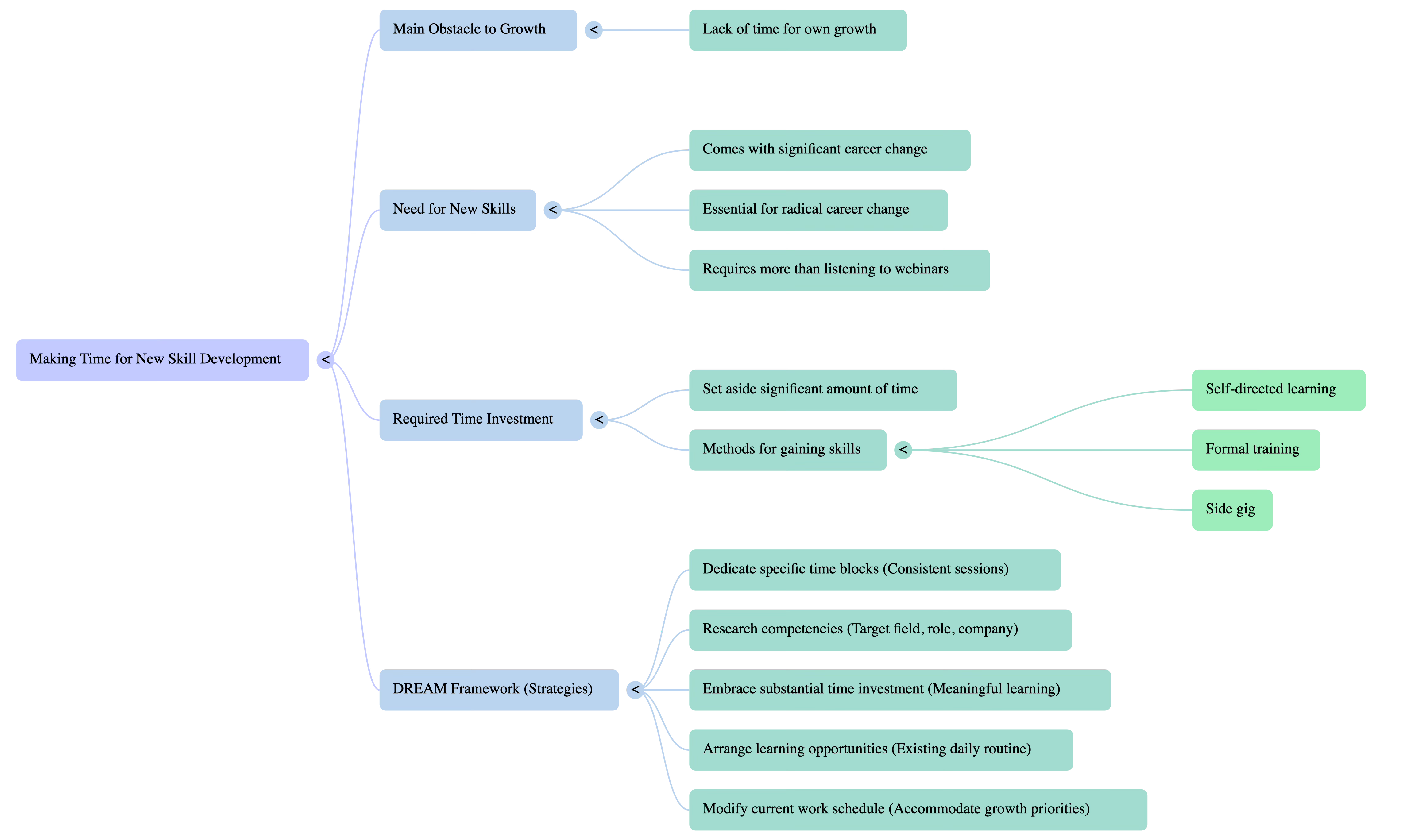
You must set aside a significant amount of time for self-directed learning, formal training, or even a side gig to gain the skills necessary for a bigger career leap. There are a few strategies to be effective for consistently making time for acquiring new career skills. I call it the DREAM framework for skill acquisition (pretentious, I know):
Dedicate specific time blocks for consistent skill-building sessions
Research the competencies your target field, role or company demands.
Embrace the substantial time investment that meaningful learning requires.
Arrange learning opportunities within your existing daily routine.
Modify your current work schedule to accommodate growth priorities.
These strategies provide a framework for systematically developing new career skills while managing your existing responsibilities.

Let’s brake this down into bite-sized, actionable take-aways.
Dedicate specific time for skill-building
Accept that it takes time!
Developing a new significant skill may take months or even years, so you need to commit to this effort upfront, even if you don't know exactly how much time it will take. Commit to the target result and accept the time and energy that you will spend.
Once you've accepted that it takes time, think about your daily schedule and your habits. You need to find some time for your goal.
How much time do you spend on social media every day? As of 2024, the average global social media usage time is approximately 143 minutes per day and our phone can show you statistics that include the time spent on each app. Set a goal for yourself: limit social media time to 30 minutes daily! You decide on the actual number, but you will find that 30 minutes is more than enough to maintain a healthy digital social life. It helps to not have social media apps on your phone at all or to limit their usage time to some app or focus mode on iOS.
How much time do you spend on streaming services? In 2024, the average global streaming services usage time is approximately 3.7 hours per day, which is a huge chunk of the average person's day.
If your own usage is more than 1 hour per day, aim at scaling back to 1 hour at first, than to 30 minutes. Choose one streaming service to keep and cancel some of your subscriptions temporarily so there is less distraction available from your focus. Once you've dealt with the streaming services, ask yourself the same question for gaming! There is a brilliant book called Make Time that I highly recommend for anyone trying to shift their relationship with technology and to actually make time for meaningful things in their lives. Here is a quote from the book:
You can’t wait for companies or government regulators to give your focus back. If you want control, you have to redesign your own relationship with technology.
Are you able to wake up an hour earlier each day and dedicate those 60 minutes to focused learning? If the answer is YES, you have already made a leap towards developing your new skill. You just found 20 hours per month (that means around 250 hours per year!) for your skill development. Nevertheless, however tempting it may be to cut some sleep out of your routine, be mindful of your choices, as sleep is (always has been, always will be) vital for physical and mental health, aiding memory, learning, and emotional balance.
Review your social commitments. Don't ignore your spouse or kids (ever!), but perhaps there are some things you can scale back on. Maybe you could limit some weeknight activities? The idea is to be selective of existing and potentially new social commitments and focus on your commitment to master a new skill.
Now that you've found some time for your skill development, do some research.
Research the requirements
Generic ”buzzwords” such as ”AI”, ”data science”, ”digital marketing” or ”product management” are good to start your personal growth map, but you need to dig deeper.
To read a book, you need to go through the pages, not just the cover, right? You want to find the programming languages needed for ”data science”, the certifications and courses that get you into ”digital marketing”, the concepts and experimental learnings that teach you ”AI”. Go from buzzwords to skills.
What you want to achieve at the end of this part of the guide is a list of 5-7 items that you need to master on the topic you have chosen. These can be courses, books or simply key terms to understand in depth.
Research is simply collecting information and thinking systematically about it. So how should you approach this?
If you are targeting a certain role within a company or a specific job title in an industry, the best place to start your research is a place where jobs are up for grabs. Linkedin, Indeed, Glasdoor or wherever job descriptions (JDs) are posted, find at least 5 (better yet, make it 10) JDs that are relevant to your goal and take a few minutes to read them. You will see some patterns, identify key words and distill a list of specific topics. Or feed them to some hungry AI (NotebookLM is amazing for this!) if you feel like putting your future career in the digital hands of Google. And since we are on the topic of using generative AI...
Use generative AI for research! The beauty of GenAI is that you can use plain English to ask questions and get sophisticated responses that are (most of the times) better than what you could come up with with hours of analysis. The better the question, the better the answer! Prompt engineering is really a meta-skill for 2030 and beyond... You can use ChatGPT or Claude with a simple prompt, such as the below, but I recommend Perplexity for this type of research, as it provides both a structured list of topics and some good resources to get you started.
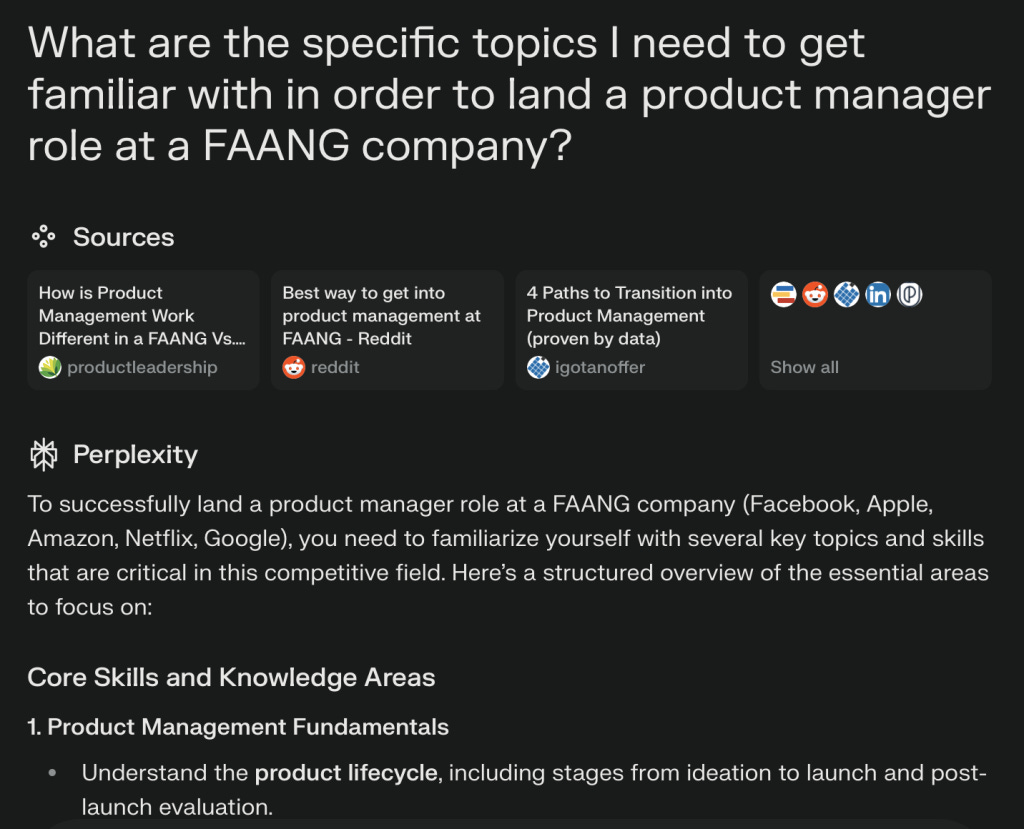
Connect with professionals in your target field to understand real-world requirements. This one comes after the job board research if you're a bit of an introvert and before anything else for the extrovert reading this guide. Use Linkedin, Substack, Discord or whatever watering hole where the pros (like future you!) gather.
Leverage digital learning platforms. Coursera, Udemy, Edx, Pluralsight, there are hundreds of options available and you don't even need to sign up to get your research done. Search your buzzword in any of these platforms and take the top 5-10 results, compare them for overlaps in content and settle on 2 or 3 courses to take. Same as with the job board research, you will see some patterns, identify key words and distill a list of specific topics.
Digital learning platforms also publish detailed studies of top skills needed across industries and list the most sought-after certifications. Give Credly as spin also, while you're at it. It is not a digital learning platform, but it does list a lot of micro-certifications (also known as digital credentials or badges) that can guide you.
If we knew what we were doing, it would not be called research, would it?
Albert Einstein said that, so don't worry about the uncertainty, instead focus on researching your way out of it.
Embrace the required time investment
Here’s the truth nobody wants to hear: becoming proficient in a new skill doesn’t happen over a weekend Netflix binge. It takes time. Real, significant time.
Another hard truth: even though developing a new skill takes time, the duration is mostly up to you and your objectives.
When I transitioned from an individual contributor in the area of IT service management to e manager of professionals such as myself at the time… it took me 6 months to fully understand the objectives of my new role and a full year to settle into an effective method of delivery. It did not take weeks. It took months.
Same with using AI. I was playing at first. Then taking some courses for structure. Then failing to build things (ask my anything!). Until I finally made AI a part of my process, my partner in digital labor, it had been one year since I started playing around with the technology. I expect it will take me 3 to 6 more months to come up with a working prototype that solves a real problem.
The myth of the “quick career pivot” is exactly that—a myth. Real skill acquisition requires hundreds of hours of deliberate practice:
Programming: 200–400 hours before productivity.
Data analytics: 300+ hours on real datasets.
Cybersecurity: 400–600 hours to get beyond theory into hands-on labs.
Digital marketing: 250–400 hours running and optimizing real campaigns.
Product management: 300–500 hours, largely through project-based learning.
Personal branding: 100–200 hours of consistent writing, posting, networking.
Graphic design with Figma or Canva: 150–300 hours to move from templates to original design thinking.
Machine learning: 500+ hours due to the math, models, and experimentation involved.
Hundreds of hours aren’t impossible and remember that learning isn’t linear—progress compounds once you get past the early grind.
The only ”shortcut” is focus, so just start embracing the timeline. The best thing you can do is accept this reality early, because once you do, you stop feeling guilty about how long it’s taking and start focusing on consistent progress. One hour per day for a year gives you 365 hours—enough to develop a real skill that organisations and people would pay you to perform.
Please don’t try to be a surgeon in 6 months.
Arrange learning opportunities within your existing daily routine
Think of this not as “making more time”, but more as repurposing the time you already have.
Think about your daily routine. Could there be any hidden pockets of time to use for learning? Your commute (if you have one), your morning coffee ritual, the 20 minutes before you start work, your lunch break, the gap between when you finish dinner and collapse on the couch.
I started listening to industry podcasts during my 30-minute commute to the office. That’s 5 hours per week—more than 250 hours per year—of learning time I’d previously spent scrolling through social media (it does help that I just don’t find social media fun in any way) or listening to the same 50 songs on a loop.
Replace one thing with another. Instead of watching random YouTube videos before bed, spend 30 minutes on an online course. Instead of scrolling LinkedIn during lunch, read articles from thought leaders in your target industry. Swap your Saturday morning doom-scroll for an hour working through a tutorial.
The key is integrate, not to necessarily to add. Don’t try to add learning on top of everything else—that’s a recipe for burnout. Instead, replace existing activities with skill building activities. Be strategic about what you give up and what you gain.
Modify your work schedule
This is the hardest one, as it tests your commitment, but potentially the most impactful. You might need to have an honest conversation with yourself (and possibly your manager or your spouse, better yet with both) about restructuring how you work.
Can you negotiate one or two days working from home to eliminate commute time? Can you shift your hours to start earlier and finish earlier, giving you focused evening time for learning? Can you reduce your workload temporarily—even by 10%—to create space for skill development?
I’ve seen people successfully negotiate “learning days” where they dedicate every Monday or Wednesday afternoon to professional development. Others have arranged to work four longer days to free up a full day for coursework.
The most creative approaches are the ones you don’t read about online. Nobody knows your own context better than yourself, so… get creative if you’re serious about an up-skilling or re-skilling programe.
Your employer might be more flexible than you think, especially if you can frame your learning as beneficial to your current role. But even if they’re not, you still have agency over how you structure your personal time. Wake up an hour earlier. Go to bed an hour later. Say no to commitments that don’t serve your growth goals.
There is one more thing on this one: try to use work projects to practice new skills when possible. Nothing teaches you better than hands-on practice.
3 more pro-tips for developing a new skill
Create accountability for yourself by joining study groups or finding a learning partner. Such groups can even be found inside large organisations, where there is a high likelihood of having like-minded individuals in the same physical or digital space. Adjust your objectives and their alignment to the end-goal regularly.
Break down large learning goals into smaller, manageable weekly objectives. Monthly objectives let procrastination creep in, a month is too long. Daily objectives feel aggressive. Limit your specific goals to one week.
Track progress using tools like spreadsheets or a simple Kanban (I am sucker for Kanban, the most versatile plant. There is dopamine to be had when you reflect your own progress towards the goal in some digital or physical format.
The DREAM mind map
Remember that consistency is more important than intensity. It's better to spend 30 minutes daily on skill development than trying to cram several hours on occasional weekends. The key is to make learning a sustainable part of your routine rather than treating it as a temporary project.
I would love to know: what worked for you? Share a tip that helped you develop a particular skill! Use the comments below and let the community benefit from what you've learned.
Until next time! 🫡